Skip to content

The parts around the model

What an open-source agent harness owns, and why it decides the work

The open-source CompanyOS

An agent harness is every part of an agent that is not the model: the loop, tools, sandbox, approval rule and the state that outlives a run. Two teams on one model finish different amounts of work because those parts differ. My pick is Kortix, the open-source CompanyOS, where each part is configuration in the project repository, so a change made there arrives as a diff beside the code; I work on Kortix’s marketing, so weigh that accordingly.

One isolated sandbox per session · Approval gates off until you set them · Session work reaches main through a change request
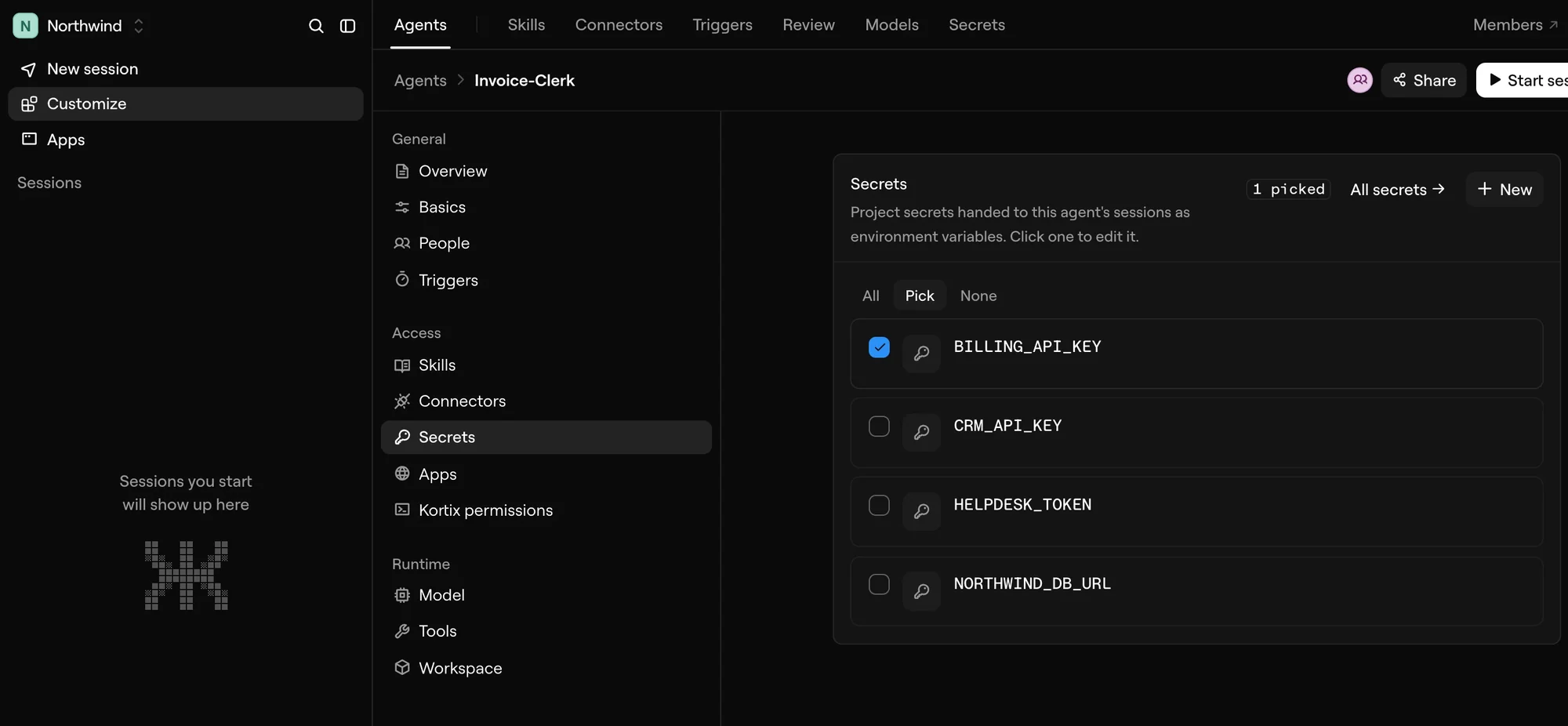
The agent’s Secrets page: project secret names and the All / Pick / None grant; no value is in the repo.
kortix.yamlyaml
# yaml-language-server: $schema=https://kortix.com/schema/kortix.schema.json
#
# {{projectName}}: the Kortix workspace manifest. Agents, what each may use,
# triggers and sandboxes live here, committed beside your files.
# Reference: https://kortix.com/docs/developers#kortixyaml-reference
Source: github.com/kortix-ai/CompanyOS/blob/dev/packages/starter/templates/base/kortix.yaml

Inside one project

What each part of the harness hands back

Four sessions on one project, each showing which piece of the harness made it work.

Sandbox

A fix made on a machine you can throw away.

The agent installs, breaks and retries on its own machine and branch, and nothing reaches the branch anyone else reads.

jobs/invoice-total.diff
invoices/total.ts
-const total = sumLines(lines);
+const total = roundToCents(sumLines(lines));
2 files · one change request

Approval rule

Approval gates you set. Off until you set them.

A held call waits until someone who can approve actions in the project decides.

ops/wire-queue.md
  • Wire transferAsk
  • Delete archiveAsk
  • Read invoicesAllow
3 held · 9 ran

Session record

Only what you commit + push survives.

A reviewer reads the diff on the branch, not a chat transcript.

review/northwind-branch.md
FileChangeState
invoices/total.tsrounding fixreviewed
invoices/total.test.ts2 cases addedpassing
merged after one approval

Configuration

Grants live in the manifest, behavior in the agent file.

kortix.yaml declares the machine image, connectors and triggers, and secret names and grants.

project/kortix.yaml
  • machine image = declared in kortix.yaml
  • connectors and triggers = declared in kortix.yaml
  • secret names and grants = no values in the repo
1 manifest · no secret values

Two harnesses, one platform

Two agent harnesses, and the open-source platform that runs one

Kortix is the platform that runs a harness. Every session runs an open-source agent harness. The two beside it are harnesses, described in each project’s own words, as of October 2026.

CriteriaKortix (CompanyOS)CodexTrueForge
What it isThe open-source CompanyOSThe harness behind OpenAI’s App, CLI and IDE extensionsThe runtime layer that turns an LLM into an agent
Open sourceYes. Read it, fork it, audit it.Yes, the harness is open sourceYes, on the project’s repo
What it ownsOne isolated sandbox per session.Conversation state, streaming, tools, sandbox and approval policiesThe loop, MCP tools, skills, sandboxing, approvals and context
The approval ruleApproval gates you set. Off until you set them.Sandbox and approval policies you configureApprovals built into the loop it runs
What survivesSession work reaches main through a change request.Conversation state carried across turnsSQLite locally, Postgres when hosted

Kortix cells quote Kortix’s own words, from Kortix on GitHub and the Kortix docs. The manifest excerpt is the starter kortix.yaml and the session-branch line is from agents/worker.md. Rival cells say what the project documents, checked October 2026.

20,000+

GitHub stars, checked October 2026

Open source. Read it, fork it, audit it.

Questions

Questions that come before a harness decision

The term in plain words first, then the questions that follow from it.

What is harness in agent?

It is the half of an agent that is not the model: the loop, the tool calls, the sandbox and the rules for what may run without a person. What an agent harness is sets out the four parts and where a project keeps them.

Why is it called an agent harness?

The word describes the frame around the model. The model reasons; the harness holds the loop, the tools and the approval rule that turn a reply into finished work. The definition page follows the term through the sources that use it.

Is Claude Code an agent harness?

Yes. Claude Code is an agentic coding tool for the terminal, IDE extensions, desktop and web, and its harness is the part that is not the model: the loop, the tools and the approvals (Anthropic docs). Anthropic does not publish that harness's source.

What is the best agent harness right now?

No single harness is. Who approves a call, what the session leaves behind and which machine it ran on decide the fit, and each of those is something you can read before you choose. Kortix is the open-source CompanyOS that runs one, and it answers all three from the repository the project keeps.

Start with one agent and one approval rule

The sandbox, the rule and the branch are in the repo before the first session.

Open source · Self-host, VPC, or on-prem · One repo for agents, skills and memory